Showing posts with label ECONOMY. Show all posts

Monday, 25 April 2011

  Who is the regulator of capital market in India?
Q. : Who is the regulator of capital market in india?
  1. RBI (it issues Govt-securities)
  2. SEBI (it securities exchange market)
  3. MoF (it decides how much G-sec to be issued)  or
  4. all three of them
  5. Ans:
  • Capital market = Primary market + Secondary market
  • SEBI controls both primary and secondary market. Means SEBI controls the entire capital market.
  • RBI is 'controller' only for Banking and not for securities.
  • MoF (Ministry of Finance) decides how much Government security is to be issued, but it for filling the Government's money requirement. It doesn't regulate the capital market, it merely participates in it to get money.

Contradiction in GDP (Expenditure) formula?
in the start of definition of gdp.....u r nt counting income of
anil kapoor or garry kirsten.....but in the topic....expenditure
method of calculating gdp....u have used exports-imports.....is this
nt contradictory.....kindly plz....xplain?

Anil kapoor-Garry Kirsten example was for GNP. [GNP= domestic product+income from abroad]

For GDP (expenditure), we've to calculate
consumption (C), Government's expenditure (G), investment(I) and eXport (X).
But what if government imports 5000 special mobile devices to print biometric UID smartcards? That is also counted in Government's expenditure accounts (G).
So, we've to deduct all the iMports (M) to prevent them from being counted into nation's GDP.
That's why


GDP (Expenditure)= C+I+G+(X-M)
Now, GNP (national product)= Domestic product + Income from abroad.
But since foreigners will be sending remittances to their families back home. So if every nation adds(+) foreigner's income (who is residing in their country) into their GNP, then it'll lead to double counting. So we've to deduct(-) the remittances. 
Hence  
GNP= GDP + Income from abroad - income earned by foreigners.

Saturday, 23 April 2011

[Economy] 3 Methods of calculating GDP
Got this question from mail,
what are these income,production and expenditure methods in calulating GDP?how do terms like NNP, NDP, GNP,GDP,NNPFC,NNPMP DIFFER FROM EACH OTHER. what is difference between gdp at constant prices and current prices. its very confusing

I'll deal with each question in one post.
Earlier I had wrote an article on GDP, GNP,NNP, 
anyways lets refresh the concepts again.

GDP (Gross Domestic Product) means,

Money value of everything you produce within your country.
(Domestic=within country).
Everything means products and services.

GNP (Gross National Product) means,


The Money value of everything you produce within your country PLUS your income from abroad. Anil Kapoor goes to America, get 5 million dollar$ to play baddie in Mission Impossible 4, but sends that money to India = counted in India's GNP.
But with same logic, Cricket Coach Gary Kirsten gets 50 lakh rupees from BCCI, and sends it to his family in S.Africa, you've to deduct it from India's GNP. (South Africans will count it in their GNP)
Similarly, Americans will subtract the dollar value of Anil Kapoor's remittance to India while counting their GNP.
So, what'll be the (stupid) formula?
Gross National production=Money value of everything produced within India+Incoming money from outside-Outgoing money to abroad.
Or you can simply say
GNP = GDP + incoming money from abroad - Outgoing money to abroad.

How GDP calculated and what is are these income, production and expenditure methods.

GDP is calculated by three methods.


Theoretically all three of them should give same final number, but in reality there will be slight difference between each of them.

#A: EXPENDITURE METHOD OF COUNTING GDP


Here you count the money spent by everyone.

So How to make a 'technical' formula? Ask yourself, where is the money changing hands? There are five components of that.
Image Hosted by ImageShack.us

#1: CONSUMPTION BY PRIVATE CITIZENS [C]


like you and me buying (overpriced) daal, vegetables and milk (courtesy: Sharad Pawar).
I buy your second-hand bike for 15,000 Rupees, should we including it in the consumer Expenditure (C) ? Nope. Because the bike Is not 'produced again.
[Image]
Second hand products are not counted

When you had bought that bike for Rs.30000, 10 years ago, we had counted that money in that year's GDP. So second hand-product sale money cannot be counted in this year's GDP.
Now, I buy your second-hand bike from an auto dealer, (who gets Rs.1000 Commission) should we include it in the (C)? Hell Yes, because he sold his 'service' to me uniquely. Every time he sells a second hand product, although no new 'product' is created but new service is delivered by him.
WHAT IF SAME 1000 RUPEE NOTE IS CHANGING HANDS?
[Image]
Each service or product has separate value even if same currency note is used to purchase it

I gave a note of Rs.1000 to that dealer as part of his brokerage (dalaali) and he gives the same Rs.1000 note to the electricity company for his monthly bill.
Same Rs.1000 note is changing hands so is our GDP =Rs.1000? Nope. GDP is the money value of everything produced within India. So brokerage service is Rs.1000 separately and the electricity produced is also worth Rs.1000 separately. Therefore, Even as same 1000 rupee note is given to both parties.
Total GDP=1000 brokeage+1000 electricity bill=Rs.2000
If electri.co gives that 1000 rupee note to its peon as salary, then again it has to be counted. Because peon sold his unique service separately to the company. So in that case
Total GDP =Brokerge+Electric bill+peon^' salary=Rs.3000

#2: Investment [I]


People investing in sharemarket, putting money in banks etc.

#3: Government spending [G]


Like buying (overpriced) sports equipment from Kalmaadi's associates during Common wealth games. Government  paying salary to staff, buying new tanks and missiles..everything.

#4, 5 :Export & Import [X & M]


Money we get from export is added.
You remember that GDP means Money value of everything we produce within India. So if we import something, it has to be subtracted, because it is not produced within India.
So formula (for ease In remembering)
GDP = Consumer+Investor+Governer + (eXporter - iMporter)
Technically correct formula:
GDP(Expenditure)=C+I+G+(X-M)

#B: Income Method of counting gdp


Here you count everyone's income. But some people may be running business in credit (udhaari), sometimes payments are delayed. So may not give the 'full picture' for the given year.

#C: Production method of counting gdp


Total money value of everything produced (value added at each stage)
  1.     Farmer produced Wheat and sold 100 kg of it @ 2000 Rs. (Original value)
  2.     Flour mill, purchased it, grinded it and sold the flour to baker @ 2500 Rs. (+500 value added to previous purchase)
  3.     Baker made breads, cookies and biscuits and sold the total production @3500 Rs to its final customers. (+1000 value added to previous purchase)

what is total 'GDP' here?
2000+2500+3500=8000 Rs? Hell no! You've to see the value added.
So, total money value of this line is: 2000+500+1000=3500.
Not all of the wheat goes into Baker's oven. Some of it will go in making beer, some in a normal household for making roti and so on. You've to track the value added in each different line.

To be continued... GDP at nominal price, Market price, Factor Cost, etc.etc.etc.

[Economy Q] GDP at Factor cost and Market price (GDPFC & GDPMP), NNPFC,NNPMP
Posted: 21 Apr 2011 02:57 AM PDT
Continuing the previous post,
GDP at Factor cost means, money value of everything produced in India, without counting Government's role in it. i.e. indirect tax and subsidies.

Example#1: Subsidy

1 kg. Urea fertilizer's original-price is 500 Rs.
When it reaches the local supplier, Government is giving 10% subsidy. So farmer purchases it @ (500-50)=Rs. 450
  1. GDP @ Factor cost= 500 [i.e. without Government's involvement]
  2. GDP @ Market price= 450 [with Government's involvement]

Example#2: Tax

Box of 10 Blank DVDs =Rs.100 +10% VAT so final M.R.P.=Rs.110
  1. GDP @ Factor cost=Rs.100 (Real value of those dvds)
  2. GDP@ Market price=Rs.110

How will you calculate GDPMP if GDPFC is given, & vice versa?

GDP@Market price=GDP@ Factor price+Government involvement
Now, Government involvement=+Indirect taxes-subsidies
So finally,
GDP@Market price=GDP@Factor cost+Indirect tax-subsidies
Or doing the reverse,  
GDP@Factor cost=GDP@market price-Indirect tax+subsidies
Still doubt (like I always had about everything in college)? Following table should clarify it.
[Image]
GDP @ Factor Cost and Market Price for same Urea and Blank DVDs

As you can see, Factor cost= Original or real value of something.
So at marketprice, even when Government is giving subsidy, the manufacturer still receives the original price. E.g. although farmer pays Rs.450, still manufacturer gets Rs.500 so we 'add' subsidy when converting MP to FC.
Similarly, even when customer pays MRP of DVD is 110, the DVD-manufacturer is still getting 100 Rs. So we 'deduct' the indirect tax(VAT) while converting MP to FC.

Similarly

NNPFC and NNPMP

GNP = everything produced inside India + Anil Kapoor's income from Hollywood - Gary Kirsten's remittance to S.Africa 
So, what is Net National product @ Factor cost, and @Market price.
Net = Gross minus depreciation. (doubt? Click me
So NNP=GNP minus depreciation.
And factor cost, market price, just as explained above..with and without Government intervention.

To be continued.. GDP @ Current Price and Constant Price, GDP deflator

[Economy Q] GDP DEFLATOR, REAL AND NOMINAL GDP
 
 GDP mean money value of everything* produced inside India.
(*Everything means goods and services.)
100 kg. of onion produced in 2009, market price = 20 Rs/kg.
100 kg of onion produced in 2010, market price =70 Rs/kg (courtesy: Sharad Pawar)
So, India's GDP has increased at the rate of 250% in a year! But the World bank and leading economists say we can hardly reach 9% GDP increase rate per year. So what is this 250%??
It's nothing but inflation. Just because onion prices rose thanks to Government's faulty food policy or black marketers, doesn't mean that real-GDP has increased and that our contry has prospered.
So how do we find real GDP for 2010, when prices of everything have increased due to inflation?
We need to compare 2010's production to some base year.
Let's pick 2003-04 as base year. So whatever price Onion had in that year, will be our base price.
IN 2003-04, average price of 1 kg onion was 30 Rs. A kilo.
2010's GDP= 1 kg onion price of base year (2003-04) *multiply* total onions produced in 2010
=30 x 100
=Rs. 3,000 is our real-GDP for 2010.

So Formula: Real GDP= Price of xyz item in base year x Quantity produced in current year.

GDP Deflator

Image: Formula


In our onion case
Nominal GDP in 2010= 70 Rs/kg x 100 kg=Rs. 7000
Real GDP as we calculated=3000.
So, GDP deflator= [7000/3000]x100= 233

What does it mean?
Here, GDP deflator is >greater than 100. That means there is inflation. (very very heavy inflation)
IF it was near to 100, that'd mean, there is no difference in real and nominal GDP hence there is no inflation in India.
We've WPI and CPI to measure inflation, but they don't include each and every product and service available in India, while with GDP deflator, we can get an inflation-picture of them too.

btw, DONOT CONFUSE ABSOLUTE GDP NUMBER WITH PERCENTAGE RISE.

Newspaper: "Montek Singh said we've got 8% GDP in 2010"
That doesn't mean India's GDP is 8%. It only means whatever was our GDP in 2009, we've increased it by 8%.
IF India produced goods and services worth 100 billion $ in 2009, then in 2010 we've produced goods n services worth 108 billion $. That's why GDP rose by 8%.
Now back in our onion example,
2009's real GDP=3000
2010's real GDP=3000
So real-GDP has rose by 0% in two years.

Monday, 18 April 2011


[Economy Q] Minimum Alternative Tax (MAT) its provisions in DTC
Question from via email
Explain Minimum Alternate Tax (MAT) and its provisions under the new Direct tax code (DTC)
Ans
First we need to understand why Government takes MAT?

Zero Tax companies


Example, A company's book-profit is 10 lakh Rupees.
Then they use some creative accounting methods like depreciation, donations etc. to claim deductions and finally their 'taxable' income is reduced to almost zero.

e.g. in 2009 during the recession time, Government of India launched a scheme to give 50% depreciation to commercial vehicles. (with assumption that it'll boost the vehicle demand and help the automobile industry to come out of the recession.)

So the company buys a truck, for 20 lakh rupees on loan.
Their deduction on first year= 50% of 20 lakh rupees= 10 lakh rupees.
Their taxable income = book profit minus deductions =10 minus 10=0.
So they don't have to pay any tax on their profit at all!

Other tricks involve donating 5,000 rupees to some religious institution run by con-man and getting donation-receipt of 5 lakh rupees. And claiming deduction! and so on..


These companies, making profit but having zero taxable income, are known as 'Zero tax companies'

Minimum Alternative Tax (MAT)

Around 1997, Indian Government realized above large-scale problem of creative accounting and tax-deduction. So it came up with MAT (Minimum alternative tax).
So if company's taxable income is less than 30% of its book profit, then it'll have to pay MAT, which is around 15% of the book profit.
Therefore, now even if above zero-tax company escapes the regular taxes, it still has to pay 1.5 lakh rupees in MAT.

Tuesday, 5 April 2011

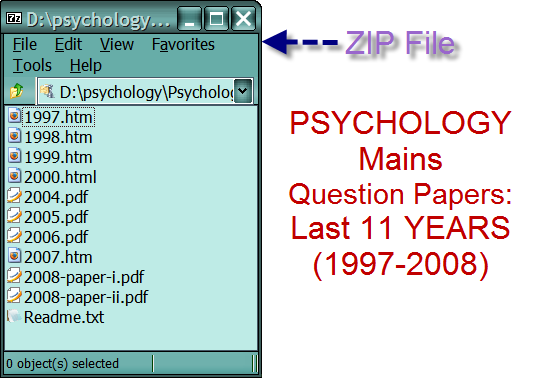
PSYCHOLOGY Mains Question Papers: Last 11 YEARS (1997-2008)


PSYCHOLOGY Mains Question Papers: Last 11 YEARS (1997-2008) for UPSC Civil service IAS/IPS Exam

Click me to Download the Zip File   (size only 350 Kilobytes!)

Here is the Screenshot

[Economy Q] How to calculate GDP (PPP) and GDP nominal?


How is PPP measured? Suppose India's GDP is Rs 100. Convert this to dollars as GDP(nominal) and GDP(PPP)
 
Answer:
 
Take a basket of commodities (like 1 kg sugar,wheat,veggies and cloths etc).
Now find out how much money do you need to buy everything from that basket?
For India suppose the bill is 1700 Rs.
Go to America and buy same items from their local market, the bill is 100$
So 100$=1700 Rs. => 1$=17 Rs.
So, PPP exchange rate is 17 Rs. per 1 $
 
To calculate GDP (PPP)
GDP (in Rupees) / PPP exchange rate for Rupees
=100/17
=5 $
India's GDP (PPP)= 5$
 
To calculate nominal GDP in $.
Just convert the Rupee into dollar at official exchange rate.1$=50 Rs.
India's GDP (in Rupees)/official exchange rate
=100/50
=2$
 
So India's GDP (nominal) is 2$.
 

[Economy Q] Credit crunch Meaning example and implications

What is Credit Crunch?

In simple words, when you can't get loans easily, its credit crunch.
Definition: reduction in the general availability of loans (or credit) or a sudden tightening of the conditions required to obtain a loan from the banks.

Examples of credit crunch

1. In America, banks were giving housing loans to any swinging dude, without checking his credit-worthiness (like can he really pay back the loan or not?). This lead to mass-defaults after few years. Now bank managers are very cautious and before processing your loan application, they'll check it 17 times! this is also a sort of credit crunch because you can't get loans that easily, like you used to get, before the recession.

2. In 3G auction spectrum, telecom companies took 70,000 cr. from Indian Banks to bid in the auction. = lot of money flew out of the system. So for a time being, banks have less money to give as loans to other customers = Credit crunch. (although that didnot happen) but suppose Mukesh Ambani had called up a bank asking for 50000 cr. loan for acquiring a foreign company next morning, Bank manager might have said 'Sir, sorry we don't have no money!"

Implications of Credit Crunch

Credit crunch is not good for economy, because
  1. A businessman wants to start new factory, but cannot get loans easily = slowdown in economy.
  2. A couple wants to buy home, but can't get home-loan easily = slowdown in real-estate sector.
  3. A college kids wants a new bike, but his dad can't get loan easily = slowdown in automobile sector, but also good from climate-change angle. as people will be forced to use public transport system ;-)

If such credit crunch continues for a long time, it'll lead to job-losses, factories shutting down and finally recession.

But sometimes credit crunch is a necessary evil, when there is too much liquidity (money) in the market.
Too much liquidity = too much money = easy to get loans = people have more money in their hands compared to the items available for purchase = hyper-inflation.

From the previous post about CRR & SLR, we can also say that an (Excessive) increase in CRR and SLR will lead to Credit crunch.

[Economy Q] ADR and GDR


What is ADR and GDR?
Answer

American Depositary Receipt (ADR)

ADR is method of trading non-U.S. stocks on U.S. exchanges
Suppose, Indian Co. wants to raise money from America, by issuing shares in American stock exchange.
But then Indian co. will have to maintain accounts according to American standards.
To prevent this problem, Indian company gives its shares to American bank.
American bank gives that Indian company receipts (called ADR) in return of those shares. Then Indian Co. can trade those ADR receipts in American share market, to raise money.

Global Depository Receipts (GDR)

Serve as same function like GDR, but on Global scale, it helps the countries from third world, to raise money from the stock exchanges in developed countries.
Several international banks issue GDRs, such as JPMorgan, Citigroup, Deutsche Bank, Bank of New York.
Normally 1 GDR = 10 Shares, but not always.

 [Economy Q] Capital and Current Account Convertibility brief explanation

QUESTIONS

1. Current account & capital account : What does that mean?
2. Current & capital account convertibility.
3. Which account is permanent & which is reversible & why?
4. Full capital account convertibility : Pros and cons
5. On which account government needs to keep close eye?

I composed the post in MS Word, but this blog-spot is not preserving the text-format, charts and tables properly. So Elaborate answer is in the PDF : CLICK ME TO DOWNLOAD (700kb)

#1: WHAT IS CURRENT AND CAPITAL ACCOUNT?

• In an open economy, we buy stuff from abroad (Import), We sell stuff to abroad.(export)
• Similarly Indians invest abroad, foreigners invest in India.
• So lot of money incoming and outgoing.
• Current and Capital accounts are nothing but method of classifying that incoming and outgoing money.
As you know, Balance of Payment (bop) = Import – Export.
This BoP is calculated under two heads: Current Account and Capital Account.
Current Account and Capital Account meaning in table
*more in pdf*

#2. CURRENT AND CAPITAL ACCOUNT CONVERTIBILITY ?

• Convertibility = converting one currency into another. Like rupee to dollar, yen to pound…anything.
• Since money is incoming and outgoing. People will need to convert the money into different currencies based on their requirements.
• We classified the incoming and outgoing money into Current and Capital account.
• Similarly we classify the procedure involved in converting that money. In brief
CURRENT AND CAPITAL ACCOUNT CONVERTIBILITY chart
CURRENT AND CAPITAL ACCOUNT CONVERTIBILITY table
*more in pdf*

#3. Which account is permanent & which is reversible & why?


• Current account =Money sent and received during import and export
• You sold something (exported) and received the money, so that money is yours forever (until you spend it on something else!) So Current account is permanent and irreversible.
• Capital account = Money sent and received during investment and borrowing.
• Suppose Japanese guy buys factory in India (capital account), sells it after 5 years and takes back the money. So Capital account inflow is NOT PERMANENT and hence reversible (because he took back the money he invested in India).

#4. FULL CAPITAL ACCOUNT CONVERTIBILITY PRO AND CONS

As we saw above, we don’t have full capital account convertibility in India.

ARGUMENT IN FAVOR OF FULL CAPITAL ACCOUNT CONVERTIBILITY

• It facilitates foreign investments and borrowing. So competition is increased = more factories = more jobs = more product choices for consumers = good for economy. :)


ARGUMENTS AGAINST OF FULL CAPITAL ACCOUNT CONVERTIBILITY

Local producers have to compete with International giants. So they lose market and customers :(
  • (Counter-argument#1: Business is about survival of the fittest, so perform or perish, ain’t no need to get sentimental about Swadeshi. Why should consumer pay for ‘not-so-good’ quality yet expensive product from a local man, if a foreigner is offering better stuff at cheaper quality?)
  • (Counter argument#2: If a few Indians lose the customers, many more Indians get jobs in those new factories started by foreigners.
What if foreigners buy lot of factories in India and suddenly they find that investing money in France is better than in India. So they immediately sell all those factories, get their Rupees converted into Euro and run away! That’ll lead to huge job loss and collapse in Indian economy!
  • (Counter argument#1: It’s a two way street: if Foreigners can do that, Indians can also do it while investing abroad.
  • (Counter argument#2: Sudden outflow of money happens only when governing institutions have weak foundations and policies. [For example, when Government is busy firefighting Sugar-Onion prices without any long-term vision, it makes cronies get involved in speculative business] If every country has sound economic policies, then it’ll be attractive to invest in every country. Then there will be no sudden outflow or inflow of money in any country and hence no-one will be misusing the full capital account convertibility.

#5.On which account government needs to keep close eye?

Sorry I don’t know that exact answer. Government needs to keep an eye on both accounts to make changes in trade policies, tax rates etc. But since Capital account inflows come with a risk (of sudden outflow collapsing the economy), so Government should keep a close eye on Capital account.

[Economy 4 Newbies] WTO & Doha made easy via Diagrams


Diagrams might not show in high resolution here, so download the PDF version by clicking me

[Economy 4 Newbies via Diagrams]
WTO & Doha
made easy by
VENKATESH
Preface-
Almost every magazine / UPSC related book / Newspaper Editorials talk about WTO  frequently. but they all use extremely complicated language,(assuming that a reader is already knowing the basic concepts of WTO & free trade. but its not true in most cases- that’s why WTO becomes a boring topic for most candidates & they end up trying to cram up Doha conference etc. with out understanding the basic concepts on WTO.
so here I try to explain WTO in as simple manner as i can.

Complicated things are intentionally left out, Many examples here, will be politically & technically ‘not correct’ but I’ve wrote it in that way so new comers can understand basic things about WTO easily.

before we understand WTO, lets see

Tariff barriers

-        Tariff = A government tax on imports or exports
-         When Indian Govt. puts heavy import duty / custom duty on Foreign Products – either that import item becomes very costly so people will buy desi* items. (and there will be smuggling of foreign items! Like Gold watches/ perfumes etc in the 80s.) *Desi= domestic / indian
-         This protects domestic players. (= industrialists/ businessmen.) from competition from foreign players.

Non-Tariff barriers.

-         When Desi players are given subsidies / preference over the foreign players by Govt. of India.
-         For example,
o       when Govt. is buying some phones/ Xerox Machines, in the tender it’ll mention that only Domestic companies can fill the tender.
o       making polices in such a way that its hard for foreign player to start factory / introduce his product in India
o       Intentionally setting the Quality standards so high that certain players can’t sell their products here.
-         Here no tariff (=tax/money) is involved but still there is a barrier for foreign players. That’s why its called Non-Tariff barrier.

what was happening before WTO.


·       Nations would put heavy custom duties on foriegn items. (to protect the domestic / Swadeshi industries)- this is called 'protectionism / Tarrif Barriers'
·       this all sounds good from patriotic point but
·       When there is less competition - products will be expansive & customer won't have much choice. for Example….. compare-
o       prices of Mobiles in 1999, with current prices!
o       features of current mobiles with 1999 (was there any MP3, radio,Camera, Color Screen etc features, if yes- how expensive was it!)
o       talk-time plans (in 1999 it was about 7 Rs./minute + incoming wasn't free, now its around 50 Paisa / minute + Free incoming/)

Today we have this fun, because of globalization + import of foreign products & Govt. doesn't put high custom / import tax on it. (no high tarrif barriers)

So, The Primary objective of WTO is to remove the tarrif barriers / Custom duties. = integrate all nations in international economy.
For this, WTO will consult with all member-nations, and will make legally binding agreements.

Why agreements?

-         there are total 19 Agreements in WTO, but most imp. are 3. (i'll explain it later in this article.)
-         these agreements talk about what is compulsory & what is non-compulsory for each nation.
-         And what will be the penalties if a nation doesn't follow these agreements.
-         Every Agreement has an 'Annex'- in that you'll find the detailed provisions & items included in the agreements.
-         The Secretariat of WTO keeps an eye on every nation – seeing whether agreements are followed or not.

But there will be some bad-nations who won't play by the rules & try to cheat such agreements. So second objective of WTO is 'Dispute Resolution'
that's like an international civil court.

Now lets see the 3 most imp agreements of WTO. See this chart
D:\Constitution\oracle\WTO\3 main.gif

Like I said ago, they’ve annexes which provide operation details about how to implement these agreements. (only TRIPS doesn’t have any annex)
Now lets see their annex 1 by 1 via charts.

Annex

#1 Annex : GATT

1 – SPS came after Doha
Now another mimp annex of GATT is, SCM = subsidies & counter veiling measures (=the Red, Green & Amber list) – see this chart-
Apart from this, shipment inspection and anti-dumping are also included in GATT annex.

#2 : Annex of GATS (services)


#3 : TRIPS – like I said ago, TRIPS doesn’t have any annex!

But TRIPS is very imp agreement in today’s world full of technologies-so lets see what’s it about t.

TRIPS =Trade related intellectual property rights

Its one of the agreement between WTO member nations.
TRIPS doesn’t have any annexes.

What is TRIPS all about?

·       In short, under TRIPS agreement, every member-nation has to make laws and tough punishments for anyone who breaks / copies other people's copyright / patent etc.

why TRIPS is imp?

·       otherwise, there will be wide spread piracy & then Inventors of 1st world won't invest / come in 3rd world market.
·       there are certain items whose actual price can't be counted based on 'physical material used in it' (e.g. Books are not sold based on number of pages/ cost of paper but content & fame of author.)  so we can't apply GATT (which is for physical goods ) and Book is not a 'service' either (so can't apply GATS) 
·       Research & Development.(R&D)
o       it takes years and billions of rupees to make a new drug.
o       but retail price of one tablet of that drug would be about 5 Rs.
o       here, if the patent / copyright wasn't protected, then inventors will not invest in R&D.& then world will be deprived of better products.
·       the GI (Geographical indicator)
o       like Darjiling tea- only the tea made in Darjiling can be sold as 'Darjiling tea'
o       otherwise, Britishers would also sell their tea claiming it to be 'Darjiling variety' and then our tea makers will face unfair compitition.

India's Problem with GI

·       Pakis also claim GI for their Basmati Rice.
·       TRIPS doesn't talk about trans-border GIs.

Time limit

·       it came in force from 1st January 1995. and according to its provision
·       Developed nations have to make such laws within 1 year.
·       developing nations (like India) have to make such laws within 5 years.
·       Least Developing countries (like Zimbabway/ Somalia)  were given time limit upto 11 years (=2006) , but now the time is extended upto  2016 for pharmaceutical patent laws.

Apart from above 3 agreements (GATT, GATS, TRIPS) other 3 imp agreements are-(see this diagram)


What is the Use of these agreements? / What are the trading principles in WTO?

Without Discrimination

·                  MFN = Most favored nation
·                  In WTO, every nation is MFN
·                  So, if India grants a special favor to one nation – India will have to give that special favor to all member-nations of WTO.
·                  India will have to treat locals & foreign players equally. (e.g. you can’t have a system like Local businessman’s file will be cleared first or local man will be given preference in contract / tenders/ 3G frequency allocation.)
·                  Exception to this principle
a.                Group of nations can form FTA = Free trade agreements
b.                Country can give special favors to 3rd world / poor nations.
c.                A nation can impose high import duty/ prevent entry of goods from a nation that’s doing unfair trade practices (like dumping* / Products dangerous to health**)
d.                But there are strict conditions in WTO, before you can do above things.
i.             *Dumping =China intentionally sends extremely cheap toys in india, so Indian toy makers collapse and toy market in India is captured by China.
ii.           ** Products dangerous to health like China’s milk powder which had melamine.

Freer Trade (bringing down barriers in international trade) –

·                  WTO agreements try to abolish following things-
1.                custom duties
2.                Quota
3.                subsidies
4.                non-tariff barriers* (explained later.)
5.                red tape
6.                Artificially propped up exchange rates
a.                like China intentionally keeps the value of Yuan low, so Americans will find it cheap to buy from China compared to other nations.)

Predictability

·                  When there are legally binding agreements between member nations of WTO- it means, even after change in Govt. (BJP / Congress / whatever) – the Indian policy of international trades won’t alter very much.
·                  This gives confidence of foreign investors because of
·                  Promise of stability (=Ceilings on customs tariffs.)
·                  policy environment is predictable.(= Transparency in trade rules)
·                  Equal treatment to Local players & foreign players. (=open access to markets)
·                  binding commitments (WTO keeps an eye on each nation – so Govt. can’t cheat. And if you cheat- you’ll have to pay fines.)
·                  And foreign investment helps the domestic economy as well.

Fair compitition

WTO agreements prevent unfair  dumping,  subsidies,  government procurement

Economic Reforms

to implement WTO Agreements, the 3rd world nations have to change their policies. = reform
(remember the pre-LPG Era - quota,licence,inspctor raj)

What was before WTO?

-         Before WTO, there was GATT.
-         GATT was criticized for being 'Rich men's club'
-         Everything in GATT used to work in a manner that'd suit the rich nations.

so WTO is better than GATT?

-         Yes, because of following reasons.
1.    WTO dispute resolution is quicker than GATT (disputes have to be solved within 18 months)
2.    in GATT, the bad-nation was free to determine its own penalty.
3.    but in WTO, bad nation has to pay high penalties for not following the rules.
4.    GATT talked only about goods (physical products) . WTO talks about services (phone lines, BPO) & Intellectual property rights, along with those goods.
5.    The working of WTO is more transparent.
6.    In WTO, every nation has one vote only. Unlike IMF where rich nations have more voting powers.

 India & WTO


first lets see what positive things happened then we talk of Doha Rounds and finally about What's India's problem in Doha rounds.

What did India Gain from WTO?

1.    India got boom in exports because WTO gradually lowered Barriers internationally.
2.    our export was only $33.22 billion in 1998-99.
3.    right now India's exports are worth more than $100 billion
4.    India won multilateral dispute settlement against such powerful economies as USA
5.    because of TRIPS, India had to adopt international standards in Intellectual property rights.=
6.    flow of Foreign investment &    technology.
7.    (because Foreigners established research labs/ manufacturing units in India & started selling their products here.)
8.    Textiles boom (because MFA = Multilateral Fiber Agreement was scrapped under WTO's ATC=Agreement on Texttile clothings.)  otherwise previously UK  and other nation had put quantitative limits on Indian Cotton's Entry in their market.

DOHA

what is DOHA?

Doha is capital city  of a small nation called Qatar.
4th Ministerial conference of WTO was held in that city in Nov.2001.
and they (member nations)  started talking about some new agreements & issues- and the talks continued.. so this entire package is called 'Doha round of talks.' aka "DDA = Doha Development agenda."
Fifth Ministerial Conference was held in  Cancun, Mexico in September  2003.

What were they talking in Doha?

Developing nations were complaining that they're facing difficulties in implementing WTO agreements.

so concessions were given to them.

1.    SPS annex added under GATT (hope you saw the previous diagram of GATT annex)
a.    SPS:   Sanitary+ Phytosanitary Measures Agreement (on farm products)
b.    Each nation can make its own Quality control rules
c.     but they've to be scientific.
2.    Earlier TRIPS (intellectual property rights) was strict.
a.    now it was relaxed- and agreement changed saying that Laws should be made which supports existing medicines and public health interest at large.

items for new negotiations in Doha

1.    Multilateral environmental agreements
2.    Trade barriers on environmental goods & services
3.    Fisheries subsidies =they  harm environment, by encouraging too many fishermen to chase insufficient fish

the Doha conference failed because it ended with out any consensus.
·       Members were divided on competition policy & transparency in Govt. procurements.
·       First world blames India to be the main villain for failure of Doha talks.

What was India's Problem in Doha?

SSM=special safeguard mechanism

·       its a measure designed to protect poor farmers by allowing countries to impose a special tariff on certain agricultural goods in the event of an import surge or price fall
·       For example, if USA sends so much cheap corn to India, that price of Corn become 50 paisa per kg. then India can put tariff barrier (= increase import duty on American Corn) so that prices become high again.
·       otherwise, no one would by Indian Corn, and our farmers will starve.
·       United States arguing that the threshold had been set too low.
·       (e.g. if it was decided that if price fall to 5 Rs. / kg corn, then India could do this. but US  wants that India shouldn't be allowed to act, unless price of corn falls very low, something like 50 paisa / kg.!)
·       India doesn't agree with US on this.
Apart from this, India has insisted on a large number of special products that would not be exposed to wider market opening

Like I said ago, more mobile companies are good. Because it increases employment. (you can be a representative of some mobile co. or if you’ve retail store, you can sell pre-paid cards etc. or you can start your own mobile repair shop and so on…)
But same is not true about agriculture sector,  since 70% of India’s population depends on one way or another with the agriculture sector. So if cheap foreign items are allowed, then it’ll create huge problem for their employment. Its easy for each American farmer to produce tonnes of grain (and sell his produce cheap), because every farmer has huge farms, latest machinery, fertilizers & great seeds+ continuous water supply + subsidy. But same is not true in India.

However the problem of food-price inflation should also be taken into account. (= read editorials, you’ll face such topics in mains / essay.)

More trouble for India

NAMA=  Non-agricultural market access negotiations
European Union has threatened to approach the World Trade Organisation (WTO) again if India does not remove the inter-state tariff disparities. “We want India to get rid of its taxes on wines and spirits in different states to allow easier access to European wines, failing which we will approach the WTO again,"

Criticism of WTO

Mostly comes from environment activities.
1.    WTO promotes industries, MNC (Multi-national corporations)
a.    But these MNCs sometimes are involved in bad things. Eg. They pay huge bribes to Burma’s military regime for operating the gas lines, nickel mines etc. and employ forced laborers in it.
2.    The infrastructure boom because of WTO (more foreign companies making factories in India) – leads to habitat / bio-diversity loss & pollution etc.
3.    Its hard to put barriers on imported items, thus the domestic industries face tough competition which sometimes ruins them. (e.g. its not possible for Indian Toy maker to compete with Chinese toys in retail price.) and yet not much the Indian Govt. can do. If they put some ban on it, then China will go to WTO, and WTO will impose heavy fines on India.
4.    3rd world has to open its market for first world product without much benefit in the reverse process. (=3rd world’s products lag in race in 1st world’s market.)
e.g. as you know in colonial era, when India was under British Rule, if we exported our Indian Textiles to Britain, they’d put huge import tax on it. Thus our cloths would become very expensive in their market. So Britishers would only buy locally made cloths from Manchester. This sort of ‘protectionism’ in old times (almost upto 1995) = their companies made lot of profit during that era & had lot profit invested in Research and technology, so currently their products will be technically and in quality far superior than ours. So even if there is no barrier today, British people will buy their product and not ours. This argument runs on the same line like of climate change. America allowed its factories to pollute the atmosphere and thus became a developed nation but now, it wants the developing nations to stop polluting the world & cut their emissions!

Timeline – Evolution of WTO

1944

·       Bretton Woods conference,
·       they wanted to make ITO (International Trade Org.) but it didn’t happen.

1947:

·       GATT (General Agreement on Trade & Tariffs) established
·       It was criticized as being  'RICH MEN'S CLUB'

1986

·       Uruguay Round of Talks
·       Service & Intellectual Property rights related topics included in the debate
·       1993, everyone agreed on it

1994 (Marrakesh, Morocco)

-         All nations signed on agreement & WTO  was established

2004

-         148 nations are members of WTO, covering 94% of international trade